Summary:
If you’ve already tried searching for dumpster prices in Nassau County, you’ve probably noticed that most companies either hide their numbers behind a “call for a quote” wall or show a low rate that somehow climbs once the invoice arrives. It’s frustrating, especially when you’re trying to plan a real project with a real budget. We give you straight answers — what dumpster rental actually costs in Nassau County in 2026, what’s driving those costs locally, how permits work across the county’s three towns, and how to make sure you’re comparing quotes fairly. No bait-and-switch, no filler.
2026 Dumpster Rental Nassau County Cost by Size
Container size is the biggest single factor in what you’ll pay, and the range across the Nassau County market is wider than most people expect. A 10-yard dumpster — the right fit for a bathroom gut, a garage cleanout, or a moderate amount of construction debris — typically runs $300 to $550 depending on the provider and what’s included. A 20-yard container, which handles most full-room renovations and larger residential cleanouts, generally lands between $400 and $850 across the local market. Thirty-yard containers for bigger jobs start around $500 on the low end and climb from there.
That spread matters. The difference between a $400 quote and an $850 quote for the same 20-yard container isn’t always about the dumpster — it’s often about what’s buried in the fine print. Disposal fees, fuel surcharges, and weight overage charges can quietly close that gap or flip it entirely. When you rent with us, the price you get upfront is the price you pay: delivery, pickup, and disposal are all included, with clearly stated weight limits so you’re not guessing.
Why Nassau County Dumpster Prices Run Higher Than the National Average
A lot of Nassau County homeowners are surprised to find that local dumpster rental costs more than what they’ve seen quoted in other parts of the country. There’s a straightforward reason for that: disposal costs in the Northeast are among the highest in the U.S., running $70 to $95 per ton at regional transfer stations and landfills. Limited landfill capacity in the New York metro area means those tipping fees don’t have anywhere to go but up — and every legitimate dumpster company passes that cost along, whether they show it to you upfront or bury it at the end.
That said, Nassau County’s position on the western end of Long Island actually works in your favor compared to eastern Suffolk. Haul distances to disposal facilities are shorter, which keeps operating costs somewhat lower than what you’d pay in Riverhead or the East End. The national average for a roll-off rental in New York runs between $642 and $824, based on data from tens of thousands of completed projects. Nassau County pricing, when quoted honestly and all-in, tends to sit within that range — sometimes below it.
The other thing worth knowing is that Nassau County is divided into three separate towns — Hempstead, North Hempstead, and Oyster Bay — and each one has its own rules around dumpster placement, permits, and fees. That fragmented regulatory environment is part of why working with a company that actually knows the area matters. A provider unfamiliar with local requirements can inadvertently leave you exposed to fines or placement violations, which adds costs that have nothing to do with the dumpster itself.
For context on what drives the higher end of the price range: weight overages are typically billed at $35 to $100 per ton above the included limit. If you’re loading heavy materials — concrete, tile, roofing shingles, or soil — it’s worth having an honest conversation about weight before you book rather than after pickup.
Dumpster Permit Nassau County: What You Actually Need and What It Costs
The permit question comes up constantly, and the answer is simpler than most people think. If your dumpster is sitting entirely on your private property — your driveway, your yard — you generally don’t need a permit in Nassau County. The permit requirement kicks in when the container occupies public space: a street, a sidewalk, or a public right-of-way.
When street placement is necessary, the rules vary by town. In the Town of Hempstead, which covers a significant portion of Nassau County and is the most populous town in the entire United States, there’s a specific $15 street placement fee per container placement under Chapter 176 of the Town Code. We carry an annual permit with the town. North Hempstead and Oyster Bay have their own processes, and the specific requirements can differ in ways that catch people off guard if they’re not familiar with local code.
The practical takeaway: we handle the permit logistics. You don’t need to call the town, figure out which chapter of the municipal code applies, or worry about whether your container is compliant. That’s part of what you’re paying for when you work with a company that’s been operating in Nassau County long enough to know these systems by name.
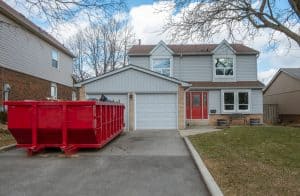
One thing that’s worth flagging if you’re in a densely built neighborhood — and a lot of Nassau County is — is that tight driveways and close-set homes sometimes make private placement tricky. Communities like Levittown, Westbury, and parts of Hempstead were largely built in the post-war era with narrower lots and shorter driveways. If you’re not sure whether your driveway can accommodate a 10-yard or 20-yard container, call us before you book. We’d rather help you figure that out in advance than show up with a container that doesn’t fit the space.
Long Island Dumpster Rental Cost: Nassau vs. Suffolk and How to Budget Smart
Comparing prices across Long Island is useful context, but it requires an apples-to-apples read. Nassau County and Suffolk County are different markets with different disposal logistics, different permit structures, and different service densities. Understanding those differences helps you evaluate what you’re actually getting when you see a quote — and whether the number on the screen reflects the real final cost.
The broader point for budgeting is this: the rental rate is only one part of the equation. Disposal fees, weight limits, overage rates, permit costs, and rental period length all factor into what you’ll actually spend. Getting clarity on each of those before you commit is how you avoid a bill that’s $200 more than you expected.

How Nassau County Prices Compare to the Rest of Long Island
Nassau County and western Suffolk County tend to be priced similarly for dumpster rentals, largely because they share access to the same disposal infrastructure and the haul distances are comparable. As you move further east into Suffolk — toward Riverhead, Southampton, or the East End — prices often climb because the haul to disposal facilities gets longer and operational costs increase accordingly.
What this means practically is that a Nassau County homeowner in Rockville Centre or Garden City is generally in a favorable position relative to someone doing the same project in Huntington or further east. The pricing advantage isn’t dramatic, but it’s real, and it’s built into the geography.
Where Nassau County does cost more than the national average is in the underlying disposal costs. The Northeast’s limited landfill capacity pushes tipping fees higher than what you’d see in the Midwest or the South, and that cost flows through to the rental price regardless of which company you use. Any quote that looks dramatically below market in Nassau County is almost certainly missing something: a weight limit so low it’s effectively unusable, a disposal fee that gets added at pickup, or a fuel surcharge that appears on the invoice but not the quote.
The most useful thing you can do when comparing providers is ask one direct question: does this price include delivery, pickup, and disposal, and what’s the weight limit? If the answer to any of those is vague or deferred, that’s your signal to keep looking.
Practical Ways to Lower Your Total Dumpster Rental Cost in Nassau County
The single most effective cost-saving move is right-sizing your container. Renting a 20-yard when a 10-yard would have handled the job means you’ve paid for capacity you didn’t use. Renting a 10-yard when you needed a 20-yard means a second delivery, a second pickup, and a second disposal fee — which almost always costs more than renting the larger size upfront. If you’re genuinely unsure, describe the project to us and we’ll tell you what size makes sense. That conversation costs nothing and can save you a meaningful amount.
Separating your debris by material type is another move that pays off. Heavy materials — concrete, brick, tile, dirt — are the fastest way to hit a weight overage. If you can keep those separate and dispose of them through a different channel, or simply be conscious of how much you’re loading, you stay within the included weight limit and avoid overage charges. Lighter debris like drywall, wood framing, and household items loads out quickly without the same weight risk.
Timing also matters in a market like Nassau County. Spring and early summer are peak season — demand spikes, availability tightens, and scheduling flexibility narrows. If your project can run in late fall or winter, you’ll generally find more availability and, in some cases, more pricing flexibility. That said, if you need a dumpster now, same-day delivery is available. The point isn’t to delay a project unnecessarily — it’s to know that timing is a lever if you have the option to use it.
Finally, if you’re weighing dumpster rental against full-service junk removal, it’s worth doing the math on both. For large projects where you’re doing the loading yourself over several days, renting a dumpster is almost always the more cost-effective option. For smaller jobs — a few pieces of furniture, a partial basement cleanout, items you can’t physically move yourself — full-service removal may actually come out cheaper per cubic yard, and it eliminates the physical labor entirely. We offer both, which means we can give you an honest answer on which one fits your situation rather than defaulting to one service.
Getting a Fair Price on Dumpster Rental in Nassau County, NY
The short version: Nassau County dumpster prices in 2026 run from roughly $300 for a small 10-yard container to $650 and up for larger sizes, with the final number depending on what’s included, how heavy your load is, and whether you need a street permit. The county’s three towns — Hempstead, North Hempstead, and Oyster Bay — each have their own permit rules, and disposal costs in the Northeast run higher than the national average, which is reflected in local pricing across all providers.
What separates a good rental experience from a frustrating one is usually transparency. A quote that includes delivery, pickup, disposal, and a clear weight limit is a quote you can actually budget around. One that leaves any of those items vague is a quote that tends to grow.
If you’re ready to get a straight number for your project — whether it’s a kitchen renovation in Mineola, an estate cleanout in Oyster Bay, or a construction job in Hicksville — reach out to us. We’ll tell you exactly what it costs, what’s included, and whether we can get a container to you today.