Summary:
Most people don’t think about dumpster permits until they’re already mid-project — or until a town inspector shows up. Nassau County has some of the most layered municipal regulations on Long Island, and the rules for placing a dumpster on a public street can change depending on which town, city, or incorporated village you’re in. The good news is that once you understand the basic framework, most situations are straightforward. This guide covers when permits apply, what the process looks like, what violations cost, and how we handle it for customers who’d rather not deal with the paperwork themselves.
Nassau County Dumpster Permit Requirements: The Core Rule
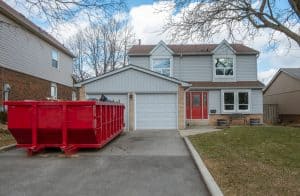
The single most important thing to understand about dumpster permit requirements in Nassau County is this: if the dumpster is going on private property — your driveway, your backyard, a private lot — you almost certainly don’t need a permit. If it’s going on a public street, a sidewalk, or any public right-of-way, you almost certainly do.
That’s the foundation. Nassau County is divided into three towns — Hempstead, North Hempstead, and Oyster Bay — plus two cities (Long Beach and Glen Cove) and 64 incorporated villages, each of which can have its own permitting authority and its own rules. There’s no single county-wide dumpster permit. The permit comes from whichever jurisdiction controls the road or right-of-way where the dumpster will sit.
Dumpster Placement Rules by Town: Hempstead, North Hempstead, and Oyster Bay
The Town of Hempstead is the largest town by population in the entire United States, and it governs a significant portion of Nassau County’s south shore and central communities — Levittown, East Meadow, Merrick, Bellmore, Wantagh, Rockville Centre, Valley Stream, and Lynbrook, among others. Street placement of dumpsters in unincorporated Hempstead falls under Chapter 176 of the town code, which specifically regulates roll-off containers on public roads. The ordinance exists because of documented safety hazards from dumpsters sitting on streets without proper visibility, particularly at night. Permits are issued on a calendar-year basis, and placement fees apply per container. Fines for skipping this step range from $20 to over $1,000 — and Hempstead enforces actively.
In the Town of North Hempstead, which covers the north shore communities like Great Neck, Port Washington, Manhasset, Roslyn, and New Hyde Park, the permit requirement kicks in specifically when the dumpster is placed on a public roadway. If that road is a town-maintained road, the permit comes from the Town’s Highway Department. If the property fronts a Nassau County road rather than a town road, the permit authority shifts to the Nassau County Department of Public Works. That distinction matters more than most people realize, and it’s one of the reasons homeowners get confused when they try to handle this on their own.
Oyster Bay, covering communities like Hicksville, Plainview, Syosset, Woodbury, Bethpage, Massapequa Park, and Farmingdale, follows a similar public-versus-private framework. Private property placements are generally permit-free. Street placements require coordination with the appropriate highway or public works authority depending on the road classification.
One more layer worth knowing: if your property sits within an incorporated village — places like Garden City, Mineola, Westbury, or Floral Park — the village may have its own building department and its own permit requirements that sit on top of the town rules. When in doubt, it’s worth a quick call to your village hall before assuming the town rules are the only ones that apply.
Nassau County Waste Regulations: What You Can and Can't Put in the Dumpster
Getting the placement permit squared away is only part of the equation. Nassau County waste regulations — along with New York State Department of Environmental Conservation rules — also govern what can actually go into a roll-off container. Putting the wrong materials in a dumpster can result in rejected loads, additional fees, or separate regulatory violations that have nothing to do with your placement permit.
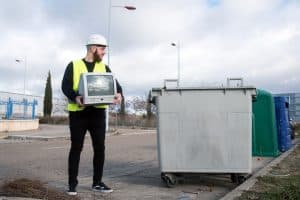
Standard household and construction debris is generally fine: furniture, drywall, flooring, roofing materials, wood, general renovation waste, yard debris, and most appliances. What’s not allowed includes anything classified as hazardous — paint, chemicals, solvents, and asbestos-containing materials. Tires are prohibited. Electronics like televisions and computers fall under New York State’s e-waste laws and require separate disposal. Appliances that contain refrigerants, like old refrigerators or air conditioning units, need certified refrigerant removal before they can be disposed of, and propane tanks are off-limits entirely.
This matters for Nassau County homeowners in particular because the county’s housing stock is largely post-World War II construction — homes built between the late 1940s and 1970s that are now being renovated or cleared out. Older homes often contain materials that require special handling: lead paint, older insulation, and in some cases asbestos in floor tiles or pipe wrap. If you’re working on a home from that era in Levittown, Uniondale, or Elmont, it’s worth knowing what you’re dealing with before you start loading the dumpster. We can help you think through what’s acceptable and what needs a different disposal path — that’s part of the service.
Nassau County Dumpster Permit Application: How the Process Actually Works
Once you know you need a permit, the next question is how to get one without it derailing your project timeline. The application process varies by municipality, but the general framework is consistent across Nassau County’s towns and the county DPW.
Most applications require the property owner’s name and contact information, the exact location where the dumpster will be placed, the planned start and end dates of the rental, the size of the container, and proof of insurance. Some municipalities require the town or county to be listed as an additional insured on the policy. Permit fees for street placement generally run between $50 and $150, depending on the jurisdiction, the dumpster size, and the rental duration. Building in at least five business days before your delivery date is the standard recommendation — though the Town of Hempstead’s online permit portal has made processing faster for many applicants.

How Long Does a Nassau County Dumpster Permit Take to Get Approved?
Processing times vary, and this is where a lot of homeowners run into trouble. If you call on a Thursday expecting a dumpster by Monday and you haven’t started the permit process, you’re cutting it close. Most Nassau County municipalities process applications within a few business days under normal conditions, but volume, staffing, and whether you’re applying online or in person can all affect the timeline.
The Town of Hempstead has improved its process with an online permit center that allows applicants to submit applications and track status digitally. If you’re in a North Hempstead community and your street is a county road rather than a town road, you’ll need to go through the Nassau County DPW, which operates on its own timeline. For homeowners in incorporated villages, add a potential stop at the village building department before or alongside the town application.
Most permits allow the dumpster to remain on the public street for up to 30 days, with extensions available if the project runs long. Extensions typically require a written request and an additional fee. If you know your project is likely to stretch beyond the initial window, it’s worth flagging that upfront rather than scrambling for an extension later. We’ve seen projects in Massapequa and Bethpage run longer than expected — a kitchen gut renovation that turns into a full bathroom addition, for example — and having that conversation early saves headaches.
The practical takeaway: don’t wait until the day before delivery to think about the permit. Give yourself a week if you can, and if you’re not sure which jurisdiction issues your permit, that’s exactly the kind of question we field every day.
Permit Violations in Nassau County: What Fines Look Like and How Enforcement Works
The fine range for unpermitted dumpsters in Nassau County — $20 to over $1,000 — is wide enough that some people assume the low end is the likely outcome. It’s not always. Fines depend on the town, the nature of the violation, how long the dumpster has been sitting without a permit, and whether the situation involves a safety hazard or a prior violation history. The Town of Hempstead, in particular, has a reputation for active enforcement, which makes sense given the density of its communities and the volume of residential streets where a dumpster creates a real traffic or pedestrian concern.
Enforcement typically starts with a complaint — a neighbor, a passerby, or a town inspector on routine patrol notices a dumpster sitting on a public street without visible permit documentation. From there, a violation notice is issued, a fine is assessed, and in some cases the property owner is ordered to remove the dumpster immediately. If the fine goes unpaid, it can escalate to legal action. A stop-work order on your renovation project is also a possibility in more serious cases, which means the $75 permit fee you skipped just cost you several days of contractor time.
There’s also a liability angle that doesn’t get talked about enough. If an unpermitted dumpster on a public street is involved in an accident — a car clips it at night, a pedestrian trips — the property owner can face liability exposure beyond the municipal fine. Permits exist partly to ensure the dumpster is placed safely, with proper reflectors and clearances, and that the municipality has a record of it being there.
The easiest way to avoid all of this is to handle the permit before the dumpster arrives. We do this for our customers regularly — it’s not a complicated process when you know who to call and what to submit, and it removes a genuine risk from your project.
Working with a Nassau County Dumpster Company That Knows the Rules
Permit requirements in Nassau County are genuinely more complicated than in most markets, and that’s not something you should have to figure out on your own while you’re also managing a renovation, an estate cleanout, or a construction project. The three-town structure, the county DPW’s separate jurisdiction over county roads, the 64 incorporated villages with their own rules — it adds up fast.
What makes the difference is working with a company that already knows which permit authority covers your street, what documents you need, and how to move quickly so your delivery date doesn’t slip. That’s exactly what we do. Transparent pricing, same-day delivery when timing allows, and no surprises on the back end — permit costs included in the conversation from the start, not tacked on after you’ve already committed.
If you’re planning a project in Nassau County and want to get the permit question answered before anything else, reach out to us. We’ll tell you exactly what applies to your address and handle the rest from there.